
Most clipping campaigns don’t fail because creators are lazy.
They don’t fail because the clips are bad.
They don’t fail because short-form content stopped working.
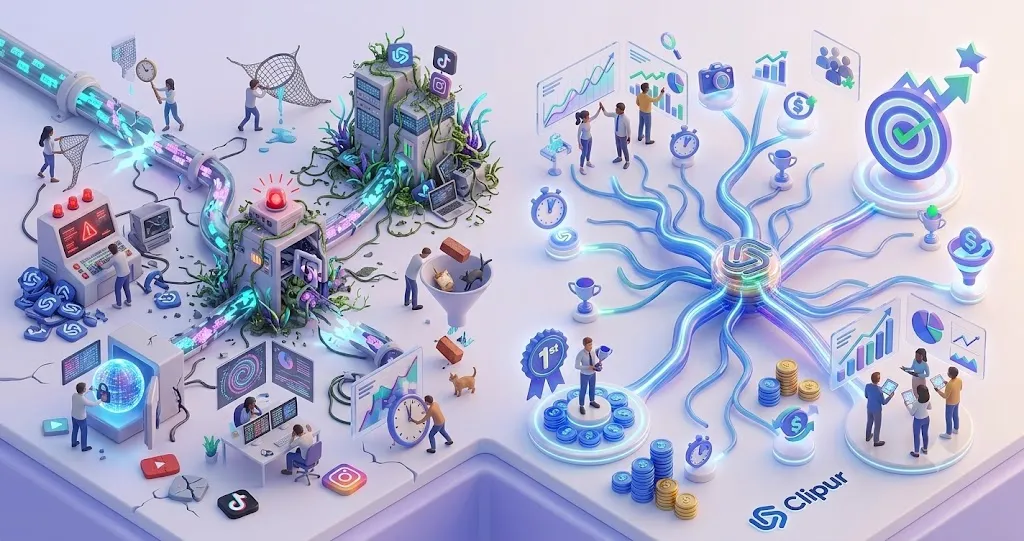
They fail because the brand unknowingly creates conditions where success becomes impossible.
After analyzing hundreds of clipping campaigns across startups, podcasts, fintech companies, e-commerce brands, creators, and media businesses, the same patterns appear repeatedly.
The frustrating part?
Most of them are preventable.
Here are the biggest mistakes we see—and what top-performing brands do differently.
Mistake #1: Treating Clipping Like Editing
This is the most common mistake.
Brands think:
“We need clips.”
What they actually need is:
“We need distribution.”
Editing is production.
Clipping is distribution.
Those are not the same thing.
A beautiful clip nobody sees has no business value.
The best campaigns start with audience and distribution strategy—not editing style.
Mistake #2: Measuring Success by Views Alone
A million views can be worthless.
Ten thousand views can change a company.
We’ve seen campaigns with:
- Massive reach
- Huge engagement
- Zero business outcomes
We’ve also seen campaigns with:
- Moderate reach
- High audience relevance
- Significant customer acquisition
Top brands measure:
- Followers gained
- Email signups
- Demo requests
- Deposits
- Purchases
- Community growth
Not just impressions.
Mistake #3: Expecting a Single Viral Clip to Save the Business
Many founders secretly want a miracle.
One clip.
One tweet.
One viral moment.
That’s rarely how distribution works.
The best campaigns resemble investing more than gambling.
Small wins compound.
Consistent distribution beats isolated virality.
Every time.
Mistake #4: Using Creators Who Don’t Understand the Niche
A fitness clipper doesn’t automatically understand fintech.
A gaming creator doesn’t automatically understand B2B SaaS.
Context matters.
The highest-performing campaigns usually emerge when creators genuinely understand the topic.
Audience trust follows.
Mistake #5: Publishing the Same Clip Everywhere
Most brands think:
One clip.
Four platforms.
Done.
The best operators understand:
TikTok ≠ Instagram ≠ YouTube Shorts ≠ X
Every platform rewards different behaviors.
Distribution requires adaptation.
Not duplication.
Mistake #6: Confusing Attention With Trust
Attention gets people to look.
Trust gets people to act.
Many campaigns generate attention.
Far fewer generate trust.
The highest-converting content often isn’t the most viral.
It’s the most believable.
Mistake #7: Ignoring the Founder
One of the strangest patterns in modern marketing:
Founders consistently outperform brand accounts.
People trust people.
Not logos.
The strongest clipping campaigns usually contain:
- Founder opinions
- Founder stories
- Founder lessons
- Founder failures
Humanity scales better than corporate messaging.
Mistake #8: Optimizing for Quantity Instead of Density
100 average clips rarely outperform:
10 exceptional clips.
Top brands ask:
“Was this worth watching?”
Not:
“How many clips did we publish?”
Mistake #9: Creating Content Nobody Wants to Clip
Some source material simply isn’t clip-worthy.
A 90-minute podcast filled with generic conversation won’t magically become great short-form content.
Great clipping campaigns begin with:
Great source material.
Garbage in.
Garbage out.
Mistake #10: Assuming Distribution Happens Automatically
Many brands think:
Publish → Growth
Reality:
Publish → Compete
Every clip enters an environment flooded with millions of alternatives.
Distribution requires intentional systems.
Not hope.
Mistake #11: Chasing Trends Instead of Building Narratives
Trends create spikes.
Narratives create businesses.
The strongest campaigns repeatedly reinforce:
- A belief
- A perspective
- A category
People remember narratives.
They forget trends.
Mistake #12: Rewarding the Wrong Creators
Bad incentive design destroys campaigns.
If creators are only rewarded for volume:
You’ll get volume.
If creators are rewarded for outcomes:
You’ll get outcomes.
Incentives shape behavior.
Every time.
Mistake #13: Treating Distribution Like a Marketing Channel
This might be the biggest misconception of all.
Distribution isn’t a channel.
It’s infrastructure.
The best companies don’t think:
“Let’s run a campaign.”
They think:
“Let’s build an asset.”
What The Best Brands Understand
The highest-performing clipping campaigns share four characteristics:
They Think Long-Term
Distribution compounds.
They Measure Business Outcomes
Not vanity metrics.
They Invest In Relationships
Creators are partners.
Not inventory.
They Build Systems
Not one-off campaigns.
The Real Goal
The goal isn’t clips.
The goal isn’t views.
The goal isn’t even virality.
The goal is building a system that consistently turns ideas into attention and attention into business outcomes.
The companies that understand this create something far more valuable than content.
They create distribution.
And in 2026, distribution may be the most valuable asset a company can own.