
Meta title: Brand Lift Clipping Campaign Measurement: Beyond Views & CPM
Meta description: Learn how to measure brand lift, sentiment, awareness, recall, and perception from clipping campaigns and short-form creator distribution.
Suggested URL slug: /blog/brand-lift-clipping-campaign
Primary keyword: brand lift clipping campaign
Secondary keyword: measuring brand awareness short form distribution
Audience: Brand marketers, performance marketers, founders, agencies, creator economy teams, comms teams
Search intent: Educational / commercial investigation
Recommended CTA: Get a Free Distribution Audit
Recommended internal links:
- The Psychology of Viral Short-Form Clips
- State of Clipping Report 2026
- What Is Creator-Powered Distribution?
- Clipping for Fintech, Trading & Financial Education Brands
- Clipping Campaigns for Online Education & Course Creators
- Clipping for Fitness, Wellness & Health Brands
- Multi-Touch Attribution Models for Clipping Campaigns
- How Much Does Clipping Cost?
Featured Image Prompt
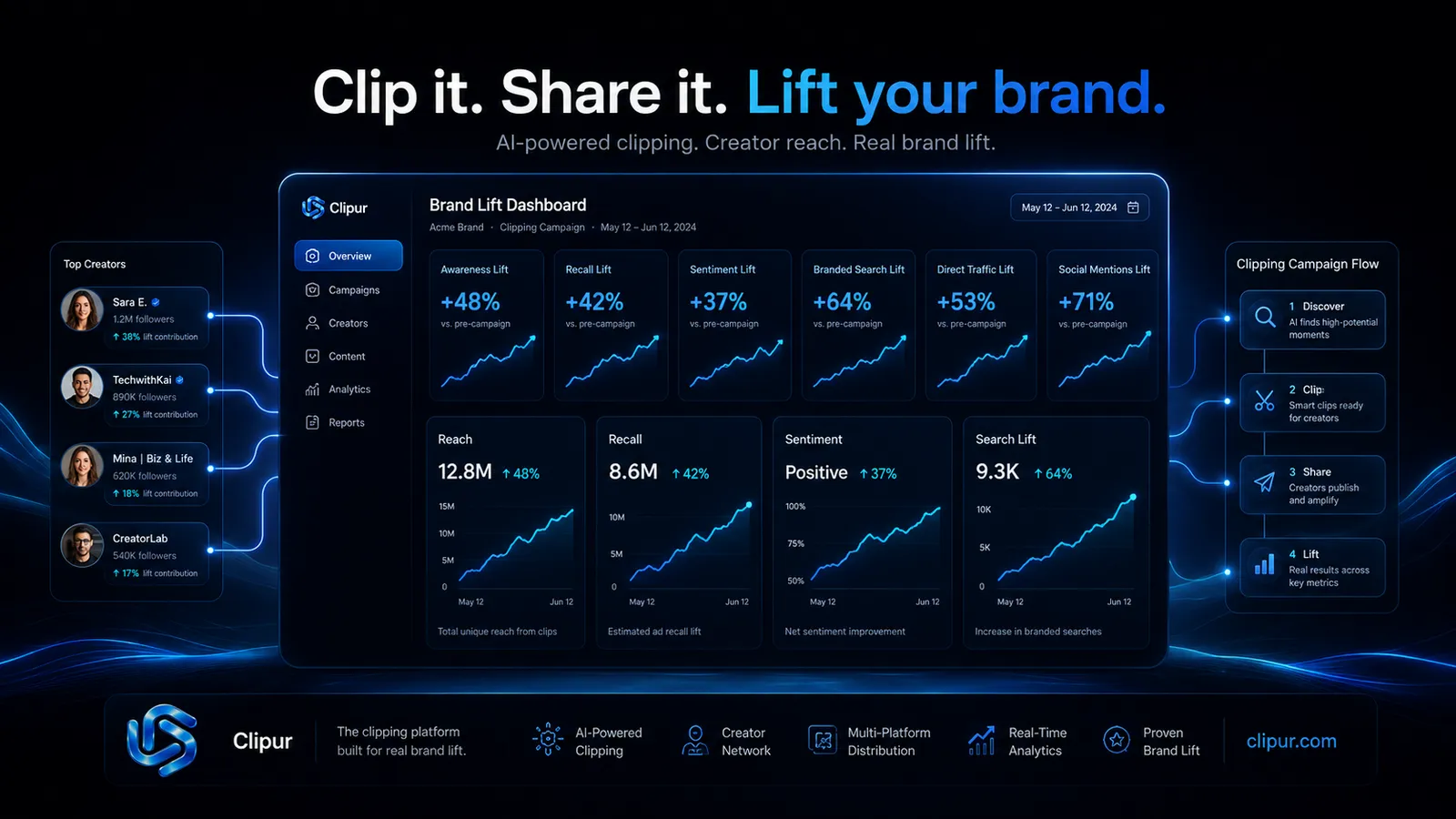
Dark, premium Clipur educational blog hero. Near-black background with electric-blue and cyan gradients. Center visual: a brand lift dashboard showing awareness, recall, sentiment, branded search, direct traffic, and social mentions rising after a clipping campaign. Creator nodes feed into charts labeled “Reach,” “Recall,” “Sentiment,” and “Search Lift.” Metallic blue Clipur icon in footer. Clean SaaS glassmorphism cards. No purple.
Brand Lift & Sentiment Measurement from Clipping Campaigns: Beyond Views and CPM
Most clipping campaigns are judged by two numbers:
Views and CPM.
That is useful, but incomplete.
A clipping campaign can generate millions of impressions and still fail if the audience remembers nothing, feels nothing, trusts nothing, and takes no downstream action.
The opposite is also true.
A campaign may produce fewer views than expected but meaningfully improve brand awareness, sentiment, category association, branded search, community conversation, and future conversion efficiency.
That is why serious marketers need to measure brand lift from clipping campaigns, not only performance metrics.
Views tell you how many people saw the content.
Brand lift tells you whether the campaign changed what people think, remember, search, discuss, and trust.
Direct Answer: What Is Brand Lift in a Clipping Campaign?
Brand lift in a clipping campaign is the measurable change in audience awareness, recall, sentiment, consideration, favorability, search behavior, or purchase intent after short-form clips are distributed across social platforms.
A proper brand lift clipping campaign measurement system combines:
- Pre-campaign and post-campaign surveys
- Social listening and sentiment analysis
- Branded search tracking
- Direct traffic and returning visitor analysis
- Comment and mention quality scoring
- Creator-level narrative analysis
- Lift studies or control-group testing where budget allows
- CRM and self-reported attribution
The goal is to answer a more strategic question than “How cheap were the views?”
The better question is:
Did the campaign make the market more aware, more favorable, and more likely to act?
Why Views and CPM Are Not Enough
Views and CPM are delivery metrics.
They tell you whether the campaign reached people efficiently.
They do not tell you whether the campaign changed perception.
A low CPM campaign can still be weak if the content is forgettable, confusing, off-brand, or attracts the wrong audience.
A higher CPM campaign can still be valuable if it reaches a concentrated buyer segment and improves brand recall, search demand, trust, or sales conversations.
This is the core measurement gap.
| Metric | What it measures | What it misses |
|---|---|---|
| Views | Exposure volume | Memory, trust, intent |
| CPM | Cost efficiency | Audience quality |
| Likes | Surface engagement | Real sentiment |
| Shares | Distribution behavior | Brand understanding |
| Comments | Conversation volume | Comment quality |
| CTR | Direct response | View-through influence |
| Signups | Captured demand | Created demand |
| Brand lift | Perception change | Requires stronger measurement setup |
The strongest clipping campaigns do not only create impressions.
They create mental availability.
They make a brand easier to remember, easier to search, easier to trust, and easier to choose later.
Why Brand Lift Matters for Short-Form Distribution
Short-form distribution works differently than traditional ads.
A brand may appear across dozens or hundreds of creator accounts. Each clip may use a different hook, edit style, caption, audience, and comment section.
That creates a distributed perception effect.
Instead of one official brand message, the market sees the brand through many social entry points.
That is powerful, but it also requires measurement.
A clipping campaign can influence:
- Brand awareness
- Ad recall
- Message association
- Sentiment
- Category recognition
- Search demand
- Founder trust
- Product understanding
- Community participation
- Purchase consideration
- Sales conversation quality
Google’s Brand Lift documentation frames brand lift as a way to measure how ads impact perception of a product or brand, while Google’s Search Lift measurement focuses on how campaigns affect a person’s likelihood to search for a product or brand on YouTube and Google Search. (Google Help)
That same logic applies to clipping campaigns.
The campaign is not only trying to generate clicks.
It is trying to increase recognition and demand.
The Brand Lift Measurement Framework for Clipping Campaigns
A strong brand lift model should measure before, during, and after the campaign.
Phase 1: Pre-Campaign Baseline
Before launching, establish baseline metrics.
| Metric | Baseline question |
|---|---|
| Unaided awareness | Do people mention your brand without being prompted? |
| Aided awareness | Do people recognize your brand when shown the name? |
| Message association | Do people understand what you do? |
| Favorability | Do people feel positively about the brand? |
| Consideration | Would they consider buying, signing up, or booking a call? |
| Branded search | How often are people searching your brand? |
| Social mentions | How often is the brand discussed? |
| Net sentiment | Are mentions positive, neutral, or negative? |
| Direct traffic | Are people visiting without a tracked link? |
| Community growth | Are people joining your audience ecosystem? |
This baseline is critical.
Without it, you are only guessing after the campaign ends.
Phase 2: Campaign Monitoring
During the campaign, track how the market responds in real time.
| Signal | What to watch |
|---|---|
| Creator post performance | Which creators produce the highest-quality reach? |
| Hook performance | Which angles create positive attention? |
| Comment quality | Are people curious, confused, excited, skeptical, or hostile? |
| Sentiment shift | Is positive sentiment increasing? |
| Share behavior | Are people reposting as endorsement, debate, or mockery? |
| Branded search | Are searches rising during campaign windows? |
| Site behavior | Are homepage, pricing, case study, and demo pages increasing? |
| Sales feedback | Are prospects mentioning the clips? |
This is where clipping campaigns become more useful than traditional paid campaigns.
Because hundreds of creator posts can create a massive qualitative dataset.
Every comment section becomes a mini focus group.
Every repost becomes a signal.
Every creator variation becomes a message test.
Phase 3: Post-Campaign Lift Analysis
After the campaign, compare results against baseline.
| Metric | Measurement method |
|---|---|
| Awareness lift | Pre/post survey delta |
| Recall lift | Exposed vs. unexposed survey comparison |
| Sentiment lift | Positive sentiment before vs. after |
| Message clarity | % of audience correctly describing the brand |
| Search lift | Branded search increase vs. baseline |
| Direct traffic lift | Direct visits increase vs. baseline |
| Community lift | New members, followers, subscribers |
| Consideration lift | Surveyed likelihood to try, buy, or book |
| Pipeline influence | CRM notes, self-reported source, assisted conversions |
A good brand lift report should not say only:
“The campaign generated 2 million views.”
It should say:
“The campaign generated 2 million verified views, increased branded search by 46%, improved positive sentiment from 38% to 57%, and increased aided awareness from 12% to 31% among the target audience.”
That is a much stronger story.
The Five Brand Metrics Every Clipping Campaign Should Track
1. Awareness
Awareness measures whether people know the brand exists.
There are two types:
| Awareness type | Meaning | Example survey question |
|---|---|---|
| Unaided awareness | They name your brand without prompting | “Which creator distribution platforms have you heard of?” |
| Aided awareness | They recognize your brand when prompted | “Have you heard of Clipur?” |
Unaided awareness is harder to earn.
Aided awareness is easier to move early.
For emerging brands, aided awareness lift is often the first meaningful signal.
2. Recall
Recall measures whether people remember seeing the brand or campaign.
Example survey questions:
- “Have you seen content about this brand recently?”
- “Which of these brands have you seen on X, TikTok, Instagram, or LinkedIn?”
- “Do you remember seeing clips about creator-powered distribution?”
Platform-native brand lift products often use exposed and control groups to estimate incremental recall. Meta’s Brand Lift documentation describes a system where eligible audiences are randomly divided into test and holdout groups, then surveyed to compare campaign impact. (Facebook)
For clipping campaigns, the same principle can be adapted manually through survey panels, audience segmentation, or exposed vs. unexposed audience samples.
3. Sentiment
Sentiment measures the emotional tone of the conversation.
Basic sentiment categories:
- Positive
- Neutral
- Negative
More advanced categories:
- Excited
- Curious
- Skeptical
- Confused
- Angry
- Supportive
- Dismissive
- High-intent
- Low-intent
Social listening platforms can help track sentiment across mentions. Brandwatch describes social listening as tracking and analyzing conversations across social media, blogs, forums, and news sites to understand what people say about a brand, industry, or topic. (Brandwatch)
Sprout Social’s sentiment analysis materials describe monitoring positive, negative, and neutral mentions over time to understand whether brand perception is improving. (Sprout Social)
For clipping campaigns, sentiment matters because distribution volume can amplify both trust and confusion.
A campaign should not only ask:
“Did people comment?”
It should ask:
“What kind of reaction did the campaign create?”
4. Message Association
Message association measures whether the audience understands the right idea.
For Clipur, the desired associations might be:
- Creator-powered distribution
- Clipping campaigns
- Short-form distribution infrastructure
- Performance-based creator marketing
- Turn long-form content into distributed reach
- Creator network for content amplification
A campaign can generate high reach but weak message association if people remember the wrong thing.
Example survey question:
“Which phrase best describes Clipur?”
Options:
- A video editing marketplace
- A creator-powered distribution platform
- A social scheduling tool
- A paid ad agency
- Not sure
The goal is not only awareness.
The goal is correct awareness.
5. Consideration
Consideration measures whether people are more likely to take action.
Example questions:
- “How likely are you to use this platform for a future campaign?”
- “Would you consider running a clipping campaign?”
- “Would you recommend this brand to a founder, agency, or marketing team?”
- “Would you book a call to learn more?”
Consideration is closer to revenue than awareness.
For B2B and high-consideration categories, this is often the most important brand lift metric.
Brand Lift Metrics by Funnel Stage
| Funnel stage | Brand metric | Business question |
|---|---|---|
| Awareness | Unaided / aided awareness | Do people know we exist? |
| Memory | Recall | Do people remember seeing us? |
| Understanding | Message association | Do people know what we do? |
| Trust | Favorability | Do people feel positively about us? |
| Intent | Consideration | Would people evaluate us? |
| Demand | Branded search / direct traffic | Are people looking for us? |
| Revenue | Pipeline influence | Did perception turn into sales motion? |
This is the difference between content performance and brand performance.
Content performance asks whether the clip worked.
Brand performance asks whether the market changed.
Survey Design for Clipping Campaigns
Surveys are the cleanest way to measure brand lift.
The best structure is simple:
- Survey the target audience before the campaign
- Run the clipping campaign
- Survey the same audience type after the campaign
- Compare awareness, recall, favorability, and consideration
- Segment results by audience, platform, and exposure
Recommended Survey Questions
| Metric | Question |
|---|---|
| Unaided awareness | “Which brands come to mind when you think about creator-powered distribution?” |
| Aided awareness | “Have you heard of Clipur?” |
| Recall | “Have you seen content about Clipur in the past 7 days?” |
| Message association | “What do you think Clipur does?” |
| Favorability | “How positive or negative is your impression of Clipur?” |
| Consideration | “How likely are you to use Clipur for a campaign?” |
| Intent | “Would you book a call to learn more?” |
| Competitor comparison | “Which platform would you trust most for short-form distribution?” |
Survey Timing
| Campaign type | Recommended timing |
|---|---|
| Short launch campaign | Baseline 3–7 days before, post-survey 3–7 days after |
| 30-day campaign | Baseline before launch, mid-campaign pulse, post-campaign survey |
| Always-on campaign | Monthly or quarterly brand tracker |
| Enterprise campaign | Exposed/control survey design |
TikTok describes its Brand Lift Study as an experiment that runs alongside sponsored content to measure incremental brand impact, although setup requires an account manager. (TikTok For Business)
For organic or creator-powered clipping campaigns, marketers can use similar survey logic even when they are not using a platform-native paid brand lift product.
Social Listening for Clipping Campaigns
Social listening is where clipping campaigns become especially valuable.
Because creator distribution produces public conversation at scale.
Track these terms:
| Query type | Examples |
|---|---|
| Brand name | Clipur, Clipur AI, Clipur.com |
| Founder name | Founder name, executive name, creator handle |
| Product terms | clipping campaigns, creator distribution, clipper platform |
| Category terms | short-form distribution, performance creator marketing |
| Campaign hashtags | branded or campaign-specific hashtags |
| Competitors | competing platforms, agencies, tools |
| Misspellings | common misspellings or nickname variations |
What to Measure
| Signal | Why it matters |
|---|---|
| Mention volume | Measures conversation growth |
| Sentiment ratio | Shows positive / neutral / negative tone |
| Topic clusters | Reveals what people associate with the brand |
| Influential mentions | Identifies high-leverage accounts |
| Repost context | Shows whether sharing is endorsement or criticism |
| Comment themes | Reveals objections and confusion |
| Competitor comparison | Shows category positioning |
| Question frequency | Reveals demand and education gaps |
A high-performing clipping campaign should increase not only mentions, but the right kinds of mentions.
Sentiment Analysis Example
Imagine a campaign generates 1.8 million views across 240 creator posts.
Surface-level report:
| Metric | Result |
|---|---|
| Views | 1,800,000 |
| Creator posts | 240 |
| Effective CPM | $1.80 |
| Comments | 6,400 |
| Shares | 2,100 |
Useful, but incomplete.
Now add sentiment:
| Sentiment category | Pre-campaign | Post-campaign |
|---|---|---|
| Positive | 31% | 54% |
| Neutral | 52% | 34% |
| Negative | 17% | 12% |
Now add topic analysis:
| Topic cluster | Share of conversation | Interpretation |
|---|---|---|
| “This is creator distribution” | 28% | Strong message association |
| “Good for agencies” | 19% | Commercial relevance |
| “How do payouts work?” | 16% | Education gap |
| “Is this better than influencer marketing?” | 14% | Category comparison |
| “Looks like a clipper marketplace” | 12% | Positioning confusion |
| Other | 11% | Long-tail discussion |
This is far more actionable than views.
The campaign did not only generate reach.
It increased positive sentiment, clarified the category, and revealed which objections needed follow-up content.
How to Correlate Reach With Brand Metrics
Brand lift measurement becomes stronger when you connect exposure to downstream movement.
Track campaign waves.
Example:
| Week | Verified views | Branded search | Direct visits | Positive sentiment | Demo requests |
|---|---|---|---|---|---|
| Baseline | — | 1,000 | 2,800 | 34% | 22 |
| Week 1 | 420,000 | 1,280 | 3,400 | 39% | 29 |
| Week 2 | 710,000 | 1,760 | 4,300 | 47% | 41 |
| Week 3 | 1,200,000 | 2,420 | 5,900 | 53% | 58 |
| Week 4 | 940,000 | 2,180 | 5,400 | 51% | 52 |
The insight is not simply that views increased.
The insight is that brand search, direct visits, positive sentiment, and demo requests moved alongside distribution.
This does not prove perfect causality by itself.
But it creates a strong directional case.
For stronger proof, use:
- Control periods
- Holdout audiences
- Geo comparisons
- Exposed vs. unexposed surveys
- Pre/post brand trackers
- CRM self-reported attribution
Case Framework: How One Brand Could Measure 3x Brand Lift From Clips
Use this as a reporting template. Replace the numbers with verified campaign data before publishing externally.
Campaign Setup
A B2B SaaS company launches a 21-day clipping campaign to increase awareness among founders, operators, and agency buyers.
The campaign distributes founder-led clips across X, LinkedIn, TikTok, and YouTube Shorts.
Baseline Survey
Before launch, the brand surveys its target audience.
| Metric | Baseline |
|---|---|
| Aided awareness | 9% |
| Unaided awareness | 2% |
| Correct message association | 11% |
| Positive sentiment | 36% |
| Consideration | 7% |
Campaign Output
| Metric | Result |
|---|---|
| Creator posts | 310 |
| Verified views | 2.4M |
| Comments analyzed | 8,200 |
| Shares / reposts | 3,100 |
| Branded search lift | +82% |
| Direct traffic lift | +61% |
Post-Campaign Survey
| Metric | Post-campaign |
|---|---|
| Aided awareness | 27% |
| Unaided awareness | 6% |
| Correct message association | 29% |
| Positive sentiment | 58% |
| Consideration | 18% |
Interpretation
Aided awareness moved from 9% to 27%.
That is a 3x relative lift.
The campaign also improved message association and consideration.
The key conclusion:
The clipping campaign did not only generate views. It increased market familiarity, clarified positioning, and improved commercial intent.
That is the kind of evidence brand marketers need.
Brand Lift Dashboard for Clipur-Style Campaigns
A proper dashboard should separate delivery, perception, and demand.
Section 1: Distribution
| Metric | Purpose |
|---|---|
| Verified views | Reach |
| Creator posts | Distribution volume |
| Active creators | Network breadth |
| Platform mix | Channel coverage |
| Top clips | Creative signal |
| Top hooks | Message signal |
Section 2: Brand Awareness
| Metric | Purpose |
|---|---|
| Aided awareness | Recognition |
| Unaided awareness | Mental availability |
| Ad / clip recall | Campaign memory |
| Message association | Positioning clarity |
| Brand search lift | Demand creation |
Section 3: Sentiment
| Metric | Purpose |
|---|---|
| Positive sentiment | Favorability |
| Neutral sentiment | Passive exposure |
| Negative sentiment | Risk / objection |
| Net sentiment | Overall perception |
| Comment themes | Market feedback |
| Creator-level sentiment | Which creators drove trust |
Section 4: Demand Signals
| Metric | Purpose |
|---|---|
| Direct traffic lift | Memory-driven visits |
| Returning visitors | Repeated interest |
| Pricing page visits | Commercial intent |
| Demo page visits | Sales intent |
| Community joins | Audience capture |
| Self-reported attribution | Dark social proof |
Section 5: Business Impact
| Metric | Purpose |
|---|---|
| Leads | Captured demand |
| Qualified leads | Buyer quality |
| Pipeline influenced | Sales impact |
| Sales notes mentioning clips | Qualitative proof |
| Close rate movement | Brand trust effect |
This is how brand lift connects to revenue without pretending every view has a direct conversion path.
Common Brand Lift Measurement Mistakes
Mistake 1: Treating Sentiment as Likes
Likes are not sentiment.
A post can get likes because people agree, laugh, criticize, debate, or signal identity.
Read the comments.
Classify the tone.
Track the themes.
Mistake 2: Ignoring Neutral Sentiment
Neutral sentiment is not always bad.
For emerging brands, neutral mentions may indicate early awareness.
The goal is often:
- Move from unknown to recognized
- Move from recognized to understood
- Move from understood to trusted
- Move from trusted to considered
Neutral awareness can be the first step.
Mistake 3: Measuring Too Late
Brand lift decays.
Survey too late and you may miss recall.
For short-form campaigns, run surveys close to the campaign window.
Mistake 4: Counting All Reach the Same
Not all reach is equal.
Segment by:
- Platform
- Creator
- Audience type
- Geography
- Buyer relevance
- Comment quality
- Sentiment
- Watch time
- Search lift
A smaller audience with stronger buyer relevance can produce more brand value than a larger generic audience.
Mistake 5: Ignoring Message Confusion
A campaign can create awareness while confusing the market.
If people remember the brand but misunderstand the product, the next campaign should focus on positioning clarity.
Measure not only:
“Have you heard of us?”
Also measure:
“What do you think we do?”
How Brand Lift Connects to Performance Marketing
Brand and performance are often treated as separate.
That is a mistake.
Strong brand lift can improve performance metrics later.
When people recognize and trust the brand, they are more likely to:
- Click retargeting ads
- Convert from branded search
- Open sales emails
- Book calls
- Accept founder outreach
- Join communities
- Refer others
- Buy faster
A clipping campaign may create the familiarity that makes the next performance campaign work better.
That is why brand lift and multi-touch attribution should be analyzed together.
Performance attribution shows where conversions were captured.
Brand lift shows whether demand was created.
The 2026 Measurement Standard for Clipping Campaigns
A serious clipping campaign should report seven layers:
| Layer | Question |
|---|---|
| Reach | How many people saw the clips? |
| Efficiency | What did attention cost? |
| Engagement | Did people interact? |
| Sentiment | What did people feel? |
| Awareness | Did more people recognize the brand? |
| Demand | Did search, direct traffic, and community growth increase? |
| Pipeline | Did awareness turn into commercial movement? |
If your campaign report only includes reach and CPM, it is under-measuring the channel.
In 2026, the best teams will treat creator-powered distribution as both a performance channel and a brand-building system.
Final Takeaway
A clipping campaign should not be judged only by views.
Views are the beginning of the measurement story, not the end.
The real question is whether the campaign changed the market.
Did more people recognize the brand?
Did sentiment improve?
Did people understand the message?
Did branded search increase?
Did direct traffic rise?
Did prospects mention the clips in sales conversations?
Did the campaign create future demand?
That is the difference between buying impressions and building brand equity.
A strong brand lift clipping campaign proves that creator-powered distribution can do more than generate cheap reach.
It can make a brand more known, more trusted, more searched, and more likely to win.
Want to Measure Brand Lift From Short-Form Distribution?
Clipur helps brands launch creator-powered clipping campaigns across X, TikTok, Instagram Reels, YouTube Shorts, and LinkedIn.
If you want to understand how short-form clips can increase awareness, sentiment, branded search, and pipeline, request a Free Distribution Audit from Clipur.
FAQ: Brand Lift Clipping Campaigns
What is a brand lift clipping campaign?
A brand lift clipping campaign measures whether creator-distributed short-form clips increase awareness, recall, sentiment, consideration, search demand, or purchase intent for a brand.
How do you measure brand lift from short-form clips?
Measure brand lift using pre/post surveys, exposed vs. unexposed audience comparisons, social listening, sentiment analysis, branded search tracking, direct traffic lift, CRM notes, and self-reported attribution.
What metrics matter beyond views and CPM?
The most important metrics beyond views and CPM are aided awareness, unaided awareness, recall, message association, sentiment, branded search lift, direct traffic lift, consideration, community growth, and pipeline influence.
Can clipping campaigns improve brand awareness?
Yes. Clipping campaigns can improve brand awareness by distributing short-form content through creator networks, increasing repeated exposure, social proof, search demand, and market familiarity.
How should sentiment be measured in a clipping campaign?
Sentiment should be measured by analyzing comments, mentions, repost context, quote posts, social listening data, and topic clusters. Basic sentiment categories include positive, neutral, and negative, but advanced analysis should also measure confusion, excitement, skepticism, and purchase intent.
What is the best survey question for brand lift?
The best survey depends on the objective. For awareness, ask “Have you heard of this brand?” For recall, ask “Have you seen content about this brand recently?” For message clarity, ask “What does this brand do?” For consideration, ask “How likely are you to use this brand?”
Why is branded search important for clipping campaigns?
Branded search is important because users often see short-form clips without clicking immediately. If they search the brand later, the campaign may have created demand even if the original clip did not receive last-click credit.
Suggested Schema Markup
Use:
- Article
- FAQPage
- HowTo
- BreadcrumbList
- Organization
Suggested FAQ schema questions:
- What is a brand lift clipping campaign?
- How do you measure brand lift from short-form clips?
- What metrics matter beyond views and CPM?
- Can clipping campaigns improve brand awareness?
- How should sentiment be measured in a clipping campaign?
- Why is branded search important for clipping campaigns?